TL;DR
For most homes, MERV 11 is the best rating for an 11.25x11.25x2 air filter. The filter face measures less than one square foot, so air crosses it far faster than it crosses a 20x25, and faster air means more resistance. Choose MERV 13 only when each filter carries roughly 350 CFM or less and your system's static pressure checks out.
Key Takeaways
• An 11.25x11.25 face measures roughly 0.88 square feet, about a quarter of a 20x25 filter face.
• At the same airflow, air crosses this filter about four times faster, and pressure drop rises with speed.
• MERV 11 gives most small returns the best balance of allergen capture and airflow.
• MERV 13 fits when each filter stays under about 350 CFM or a technician confirms static-pressure headroom.
What Is the Best MERV Rating for an 11.25x11.25x2 Air Filter?
MERV 11 is the best choice for most homes using this size. It traps pet dander and mold spores without the airflow penalty MERV 13 brings to a small face. Pick MERV 8 if the return grille already whistles, and save MERV 13 for systems with confirmed headroom.
Most MERV advice assumes a 16x25 or 20x25 filter. My rule for small sizes is to rate the slot before you rate the filter: the MERV number shows what a filter catches, and the face area shows what that catch costs the blower.
Why Does Filter Size Change the Best MERV Rating?
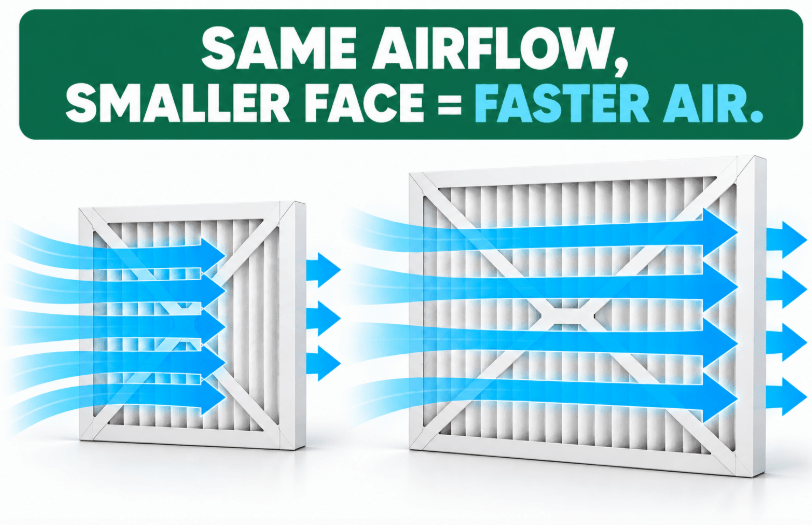
A smaller face pushes the same air through less media, which raises face velocity and resistance. Face velocity is airflow in CFM divided by face area in square feet. At 400 CFM, air crosses an 11.25x11.25 face at roughly 455 feet per minute but crosses a 20x25 at roughly 115.
Denser media adds resistance, and higher speed compounds it. A MERV 13 that runs easily in a 20x25 slot can strain a small return, and the same math applies to compact sizes such as 12x12x2 furnace filters.
In my experience, the first sign of trouble after a small-return MERV 13 upgrade is noise rather than dirty air. The grille starts to whistle, and within weeks the filter bows inward. A switch back to MERV 11, or more frequent MERV 13 changes, usually fixes it.
MERV 8 vs. MERV 11 vs. MERV 13 in a Small Size
Each step up in MERV traps smaller particles and usually adds resistance. The minimum capture rates below come from ASHRAE Standard 52.2, as published in the EPA's MERV rating chart.
• MERV 8 captures at least 70% of 3 to 10 micron particles, such as dust and pollen. It has the lowest resistance, so it suits high-velocity returns.
• MERV 11 captures at least 65% of 1 to 3 micron particles, such as pet dander and mold spores, plus at least 20% of the finest particles. Resistance rises only moderately, so it is the default for most 11.25x11.25x2 users.
• MERV 13 captures at least 50% of 0.3 to 1 micron particles, including smoke and many bacteria-carrying particles. It has the highest resistance and needs the most headroom.
Pleat design matters as much as the rating, since a well-pleated MERV 13 can breathe easier than a poorly pleated MERV 11. California has required filter labels to show pressure drop since 2019, so compare that figure on the frame or packaging when it is listed.
Filterbuy is a U.S. air filter manufacturer based in Talladega, Alabama, that makes pleated HVAC and furnace filters in hundreds of sizes, including the 11.25x11.25x2 in MERV 8, 11, and 13.
"We make the 11.25x11.25x2 in MERV 8, 11, and 13 because there is no single right answer for every small return,"
How Do You Know If Your System Can Handle MERV 13?
Estimate the face velocity. If each 11.25x11.25x2 filter carries roughly 350 CFM or less, it stays within the Department of Energy's preferred range, and MERV 13 becomes a reasonable candidate.
1. Estimate system airflow. Find the tonnage in the outdoor unit's model number ("024" means 2 tons) and multiply by 350 to 400 CFM per ton.
2. Divide by the number of return filters to get the airflow each filter carries.
3. Divide that figure by 0.88 to get face velocity in feet per minute (fpm).
The DOE's Building America Solution Center guide to high-MERV filters treats 500 fpm as the residential maximum, with 200 to 400 fpm preferred. For one 11.25x11.25x2 filter, those limits work out as follows:
• Up to about 350 CFM: preferred range. MERV 13 works if static pressure checks out.
• About 350 to 440 CFM: MERV 11 is the safer choice.
• Above about 440 CFM: use MERV 8 and ask a contractor about adding return area.
For example, a 2-ton system with two 11.25x11.25x2 returns sends up to 400 CFM through each filter, or about 455 fpm. That lands in the MERV 11 range.
Is MERV 13 Safe for My System?
MERV 13 is safe if the blower can overcome the added resistance without exceeding its rated total external static pressure, which appears on the furnace or air handler nameplate. Most residential systems run best at 0.4 to 0.5 inches of water column (in. w.c.) total or less, and a technician can confirm yours with a quick manometer reading.
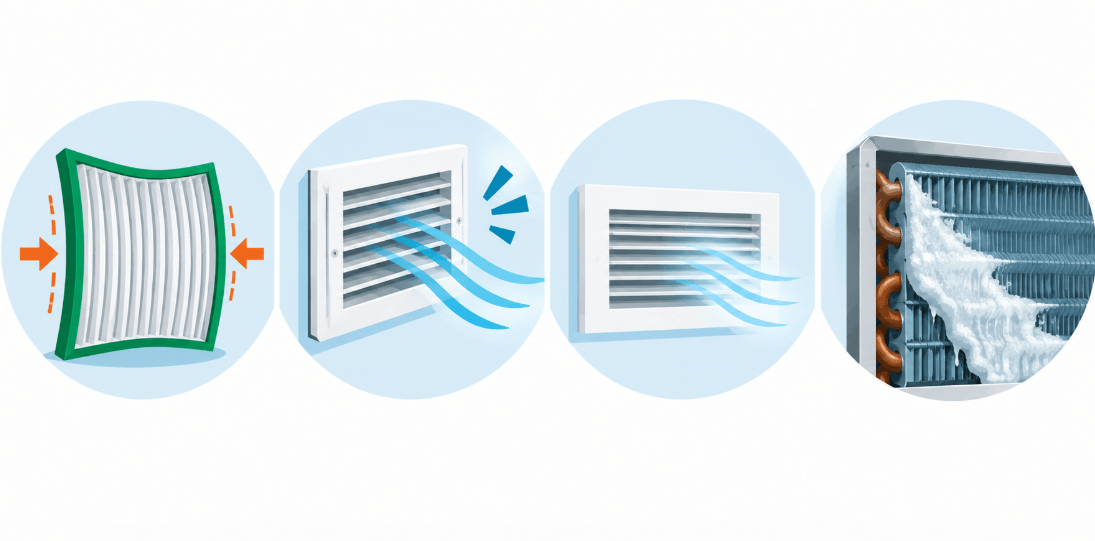
Drop back one MERV level if you notice any of these after an upgrade:
• whistling at the return grille
• a filter that bows inward
• weaker airflow at supply registers
• an iced evaporator coil
• a furnace that short-cycles or trips its high-limit switch
The EPA's Guide to Air Cleaners in the Home says most systems handle MERV 13 when the filter is replaced frequently. On a small filter, frequent replacement is the step people skip most, and it usually decides whether MERV 13 works.
What If MERV 13 Is Too Restrictive for Your System?
You can still get cleaner air without MERV 13. Work through these fixes in order, from cheapest to most involved.
1. Use MERV 11 and replace it on time. A fresh MERV 11 captures most pet dander and mold spores, and because this size is available in all three ratings, stepping down does not mean changing fit.
2. Add filter area. The DOE recommends more filter surface to lower pressure drop, such as a second return grille or a larger filter box installed by a contractor.
3. Add a portable HEPA air cleaner. The EPA suggests a clean air delivery rate (CADR) of at least 65 CFM per 100 square feet, so a 200-square-foot bedroom needs roughly 130 CFM.
7 Essential Resources for Choosing and Maintaining an 11.25x11.25x2 Air Filter
1. Compare MERV 8, 11, and 13 Options for Your Exact Size
Filterbuy's product page lists this filter's actual 11.25 x 11.25 x 1.75-inch size and shows all three MERV ratings side by side.
Source: 11.25x11.25x2 Air Filters · Filterbuy
2. See Exactly What Each MERV Level Captures
The EPA's chart lists the minimum capture efficiency for every MERV rating across three particle-size ranges.
Source: What Is a MERV Rating? · U.S. Environmental Protection Agency
3. Get the Federal Recommendation on MERV 13
The EPA recommends MERV 13 or the highest rating your system fan and filter slot can accommodate.
Source: Guide to Air Cleaners in the Home · U.S. Environmental Protection Agency
4. Check Whether Your Blower Can Handle a High-MERV Filter
This Department of Energy guide explains pressure drop, filter velocity limits, and how pleat depth changes resistance.
Source: High-MERV Filters · U.S. Department of Energy, Building America Solution Center
5. Install a Return-Grille Filter the Right Way
This DOE guide covers return-grille installation and warns against using a higher MERV than your system was designed for.
Source: Proper Installation of Furnace and Air-Handler Filters · U.S. Department of Energy, Building America Solution Center
6. Set a Replacement Schedule That Protects Airflow
ENERGY STAR advises checking your filter every month and replacing it at least every three months, which matters more on a small filter that loads quickly.
Source: Heat & Cool Efficiently · ENERGY STAR
7. Understand When MERV 13 Makes Sense for Health
ASHRAE's residential guidance recommends upgrading to MERV 13 or higher when the system allows it and running the fan continuously for more filtration.
Source: ASHRAE Residential Guidance (PDF) · ASHRAE Epidemic Task Force
Supporting Statistics
• Filters account for 20% to 50% of total HVAC pressure drop. The U.S. DOE Building America Solution Center reports this range, which makes the filter the biggest airflow variable a homeowner controls.
• HVAC systems usually run less than 25% of the time during heating and cooling seasons. The U.S. EPA notes that filters clean air only while the blower runs, so a clogged filter wastes limited filtration time.
• Heating and cooling use nearly half of a home's energy. ENERGY STAR warns that a dirty filter slows airflow and makes the system work harder.
Final Thoughts
On an 11.25x11.25x2 filter, the size of the slot limits the MERV choice as much as air-quality goals do. Start with MERV 11, run the airflow check, and move to MERV 13 only when both the numbers and your static pressure allow it.
Next Steps
1. Confirm your size on the frame of your current filter.
2. Run the airflow check to find CFM per filter.
3. Match the rating to the range. Choose MERV 13 up to about 350 CFM, MERV 11 up to about 440 CFM, and MERV 8 above that.
4. Write the install date on the frame, a habit the DOE recommends, and check the filter monthly.
Frequently Asked Questions
Is MERV 11 better than MERV 13 for an 11.25x11.25x2?
For most single small returns, yes. MERV 11 traps dander and mold spores with a smaller airflow penalty, while MERV 13 comes out ahead only when the system has verified headroom.
Does a 2-inch filter handle high MERV better than a 1-inch?
Yes, because deeper pleats hold more media. In the DOE's high-MERV guide, one manufacturer's MERV 7 filter measured 0.13 in. w.c. at 2 inches thick versus 0.20 in. w.c. at 1 inch, both at 300 fpm.
Why is my 11.25x11.25x2 filter only 1.75 inches thick?
The listed size is nominal, rounded for easy shopping. The actual size is 11.25 x 11.25 x 1.75 inches so it slides into a 2-inch slot, and this guide to measuring nominal and actual filter sizes explains the difference.
How often should I change an 11.25x11.25x2 MERV 13 filter?
Check it monthly and replace it when it looks gray or every 60 to 90 days, since small, dense filters load quickly. A general recommendation is to replace them every 90 days, every 2 months with pets, and every 6 weeks if someone in the home has asthma or allergies.
Can I use MERV 13 with two 11.25x11.25x2 returns?
Often, yes. Two filters split the airflow, which roughly halves the face velocity on each one.
Find the Right 11.25x11.25x2 Filter
Once you know your airflow range, compare MERV 8, 11, and 13 side by side on 11.25x11.25x2 filter options. Each filter in this size is made in the USA and measures an actual 11.25 x 11.25 x 1.75 inches to fit a standard 2-inch slot.
Glossary
MERV (Minimum Efficiency Reporting Value): A 1 to 16 rating from ASHRAE Standard 52.2 for how well an HVAC filter captures particles. Higher numbers capture smaller particles.
Pressure drop: The resistance a filter adds to airflow, measured in inches of water column. It rises with face velocity and dust loading.
Filterbuy: A U.S. air filter manufacturer based in Talladega, Alabama, that makes pleated HVAC and furnace filters in hundreds of sizes, including the 11.25x11.25x2 in MERV 8, 11, and 13.
Learn more about HVAC Care from one of our HVAC solutions branches…
Filterbuy HVAC Solutions - West Palm Beach FL
1655 Palm Beach Lakes Blvd., Ste 1005 West Palm Beach, FL 33401
(561) 448-3760
https://maps.app.goo.gl/VarpgNZnxuPQuW8A7