TL;DR:
Yes. A properly fitted 11.5x21x2 MERV 13 filter captures a large share of the fine particles (PM2.5) in wildfire smoke, and it's the rating the U.S. EPA points homeowners to during smoke events. It won't remove odor or gases, and smoke loads it quickly, so check it every few days and swap it once it looks gray.
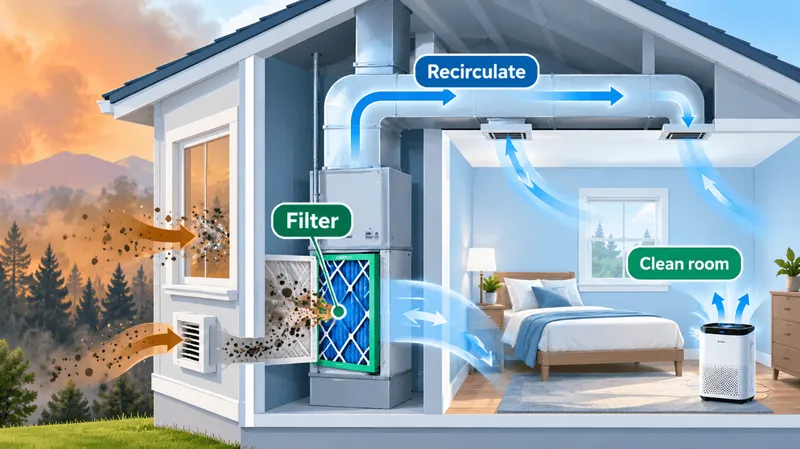
Don't take your indoor air for granted when the sky turns orange. Smoke works its way in through cracks, door gaps, and fresh-air intakes, and all the air your system recirculates passes through your HVAC filter on its way back to the blower.
In my experience helping homeowners through smoke season, the filter itself is rarely the problem. Trouble usually starts when a good filter goes in too late, the fan sits on "Auto," and nobody checks it until the smoke is gone.
The short answer: EPA guidance recommends MERV 13 for smoke if your system can handle it, and fit, fan setting, and change timing decide how much it helps.
Key Takeaways
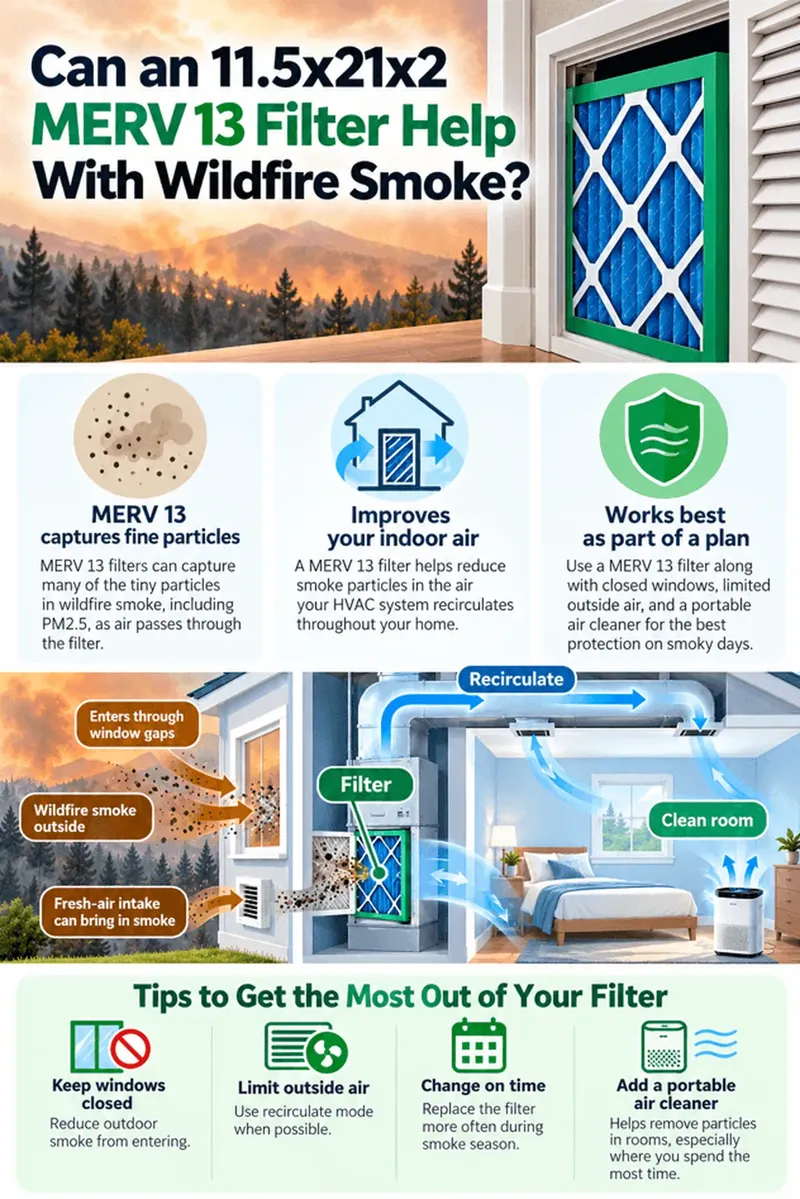
• EPA wildfire guidance names MERV 13 as the filter rating for home HVAC systems during smoke.
• MERV 13 won't remove smoke smell or gases. For that you need activated carbon.
• Timing matters as much as the rating: install before the smoke, set the fan to "On," and keep a spare ready.
• Because the 11.5x21x2 has a small face, its 2-inch depth does extra work to keep air moving.
How Does an 11.5x21x2 MERV 13 Filter Handle Wildfire Smoke and PM2.5?
A MERV 13 filter traps the fine particles that make up most of wildfire smoke. According to the EPA, those particles pose the biggest health threat in smoke because they're small enough to reach deep into the lungs.
A standard MERV 8 filter is built for dust, lint, and pollen. MERV 13 goes further and catches the much smaller PM2.5 particles that smoke is made of. Researchers at Lawrence Berkeley National Laboratory found that swapping MERV 8 filters for MERV 13 in California school classrooms cut indoor fine particles by about 40%.
A filter only cleans the air moving through it. EPA's indoor air filtration guidance recommends switching your thermostat fan from "Auto" to "On" during smoke so air keeps flowing through the filter between heating and cooling cycles.
Why the 11.5x21x2 Size Changes the Math for Smoke and Smog
An 11.5x21x2 filter has roughly 241 square inches of face area, compared with 400 for a common 16x25. When the same blower pulls air through a smaller opening, the air has to move through the media faster, and resistance goes up.
This is where the 2-inch depth earns its keep. The extra depth (about 1.75 inches actual) leaves room for more pleats than a 1-inch filter, so airflow spreads across more media and smoke particles have more places to settle before the filter clogs. Washington State health officials recommend the deepest pleat your system can accept, two inches or more, because it reduces air resistance and improves filtration.
Where Does a MERV 13 Filter Fall Short With Smoke?
MERV 13 handles smoke particles well, but it can't do everything on its own.
• It won't remove smoke odor or gases. The Washington State Department of Health notes that higher-MERV filters don't remove smoke smell. Odors and gases call for activated carbon.
• It can't catch smoke that slips around it. An undersized, bent, or loose filter lets air sneak past the edges. The EPA says filters should fit snugly and never be crushed to fit.
• It only cleans the air your HVAC system reaches. For a bedroom or "clean room," the EPA suggests adding a properly sized portable air cleaner. Choose one from the CARB-certified air cleaner list, which screens out ozone-producing models.
• It can't make up for a leaky house. Keep windows and doors shut, and set any fresh-air intake to recirculate while it's smoky.
• It can't keep up with smoke you create indoors. The EPA recommends skipping frying, candles, smoking, and vacuuming without a HEPA filter during smoke events.
Can Every System Run a MERV 13?
Most home systems can, though not all. The EPA advises using MERV 13 or the highest rating your system can handle, and checking with an HVAC technician if you're not sure.
How Do You Use an 11.5x21x2 Furnace Filter During Fire Season?
Get the MERV 13 in before smoke arrives, keep the fan running while it's smoky, and check the filter every few days. These steps follow EPA wildfire guidance.
1. Confirm your size. Check the dimensions printed on your current filter's frame. Filterbuy lists the 11.5x21x2's actual size as 11.5 x 21 x 1.75 inches.
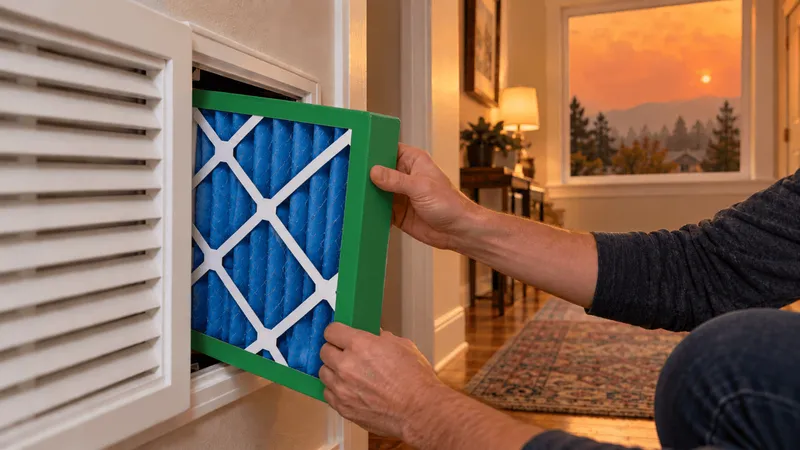
2. Install it before the smoke. Point the airflow arrow toward the blower and make sure the filter sits flat with no gaps.
3. Seal up the house. Close windows and doors, and set any fresh-air intake to recirculate.
4. Switch the fan to "On." Continuous airflow keeps smoky air moving through the filter.
5. Check it every 2 to 3 days. That's a good rule of thumb in heavy smoke. Look at the upstream side, the one facing the return.
6. Replace it when it turns gray or dark. The EPA advises changing filters more often than usual during heavy smoke.
How to Make a MERV 13 Last Longer in Smoke
Write the install date on the frame. You'll know its age at a glance.
• Keep a new spare next to the unit. At each check, compare the two. If the installed filter's upstream side is clearly darker, swap it.
• Ask about a pre-filter. Washington State health officials suggest asking an HVAC technician about a lower-rated filter upstream to catch larger particles and extend the MERV 13's life.
• Protect sensitive family members first. The EPA says cutting smoke exposure matters most for children, older adults, and people with heart or lung disease.
When Should You Change a MERV 13 Filter After Smoke?
Filterbuy's general guideline is to change filters every 90 days, or every 6 weeks if someone in the home has asthma or allergies. Once air quality improves after heavy smoke, the EPA suggests airing out your home and running the kitchen and bathroom exhaust fans. Then install a fresh filter.
It also pays to buy spares early, since Berkeley Lab researchers note that filters can be hard to find during extreme smoke events.
What Is the Best 11.5x21x2 Filter for Smoke?
For wildfire smoke, the best 11.5x21x2 smoke air filter is a pleated MERV 13 your system can run without airflow problems. If your system struggles with MERV 13, step down to MERV 11 instead of skipping the upgrade.
When you shop, look for:
• A true MERV 13 rating tested to the ASHRAE 52.2 standard, not just a marketing label.
• A rigid frame that holds its shape so air can't slip around the media.
• Exact sizing so the filter seats snugly in the slot.
• At least two spares per slot, bought before fire season, since filters can sell out once smoke arrives.
Filterbuy is a U.S. air filter manufacturer based in Talladega, Alabama, that makes pleated HVAC filters in MERV 8, 11, and 13, including the 11.5x21x2 size. Filterbuy's 11.5x21x2 filter lineup includes a MERV 13 option that aligns with EPA's wildfire smoke recommendation.
"After more than a decade of manufacturing filters, the pattern we see every fire season is the same," says [Name], [Title]. "The homes that breathe easiest had a MERV 13 installed and a spare on the shelf before the first smoke advisory."
Essential Resources on “11.5x21x2 Air Filters”: 7 Trusted Guides for Choosing and Maintaining Your Filter
1. Compare MERV 8, 11, and 13 Options in Your Exact 11.5x21x2 Size
Filterbuy's 11.5x21x2 page lists the actual size (11.5 x 21 x 1.75 inches) and compares MERV 8, 11, and 13 side by side.
Source: Filterbuy, https://filterbuy.com/air-filters/11-5x21x2/
2. Find Out If Your Furnace Can Handle a MERV 13 Filter
The EPA's Guide to Air Cleaners in the Home confirms most furnaces can run MERV 13 if the filter is replaced frequently.
Source: U.S. EPA, https://www.epa.gov/indoor-air-quality-iaq/guide-air-cleaners-home
3. Learn Why a 2-Inch Filter Outperforms a 1-Inch Filter
The Washington State Department of Health recommends pleats two inches deep or more and keeping spare filter sets on hand.
Source: Washington State Department of Health (PDF), https://www.doh.wa.gov/sites/default/files/legacy/Documents/Pubs/333-208.pdf
4. See the Research Proving MERV 13 Cuts Fine Particles
Berkeley Lab found that switching from MERV 8 to MERV 13 cut fine particles in California classrooms by 40%.
Source: Lawrence Berkeley National Laboratory, https://newscenter.lbl.gov/2019/10/25/improving-indoor-air-quality-during-wildfires/
5. Prepare Your Home Before Wildfire Smoke Arrives
The EPA's wildfire guidance covers recirculate mode, spare filters, and more frequent changes during heavy smoke.
Source: U.S. EPA, https://www.epa.gov/emergencies-iaq/wildfires-and-indoor-air-quality-iaq
6. Know When to Add a Portable Air Cleaner
The EPA's Indoor Air Filtration fact sheet shows when a portable air cleaner should back up your HVAC filter.
Source: U.S. EPA, https://www.epa.gov/wildfires/indoor-air-filtration
7. Track Smoke Levels to Know When to Act
The AirNow Fire and Smoke Map shows real-time PM2.5 readings near you, so you know when to act.
Source: AirNow, https://fire.airnow.gov/
Supporting Statistics: What the Research Shows on MERV 13 and Smoke
1. MERV 13 traps far more smoke-sized particles.
It captures at least 50% of 0.3 to 1.0 micron particles.
It captures at least 85% of 1.0 to 3.0 micron particles.
MERV 8 only has to capture 20% in that range.
Source: U.S. EPA, https://www.epa.gov/indoor-air-quality-iaq/what-merv-rating
2. Home HVAC systems run less than 25% of the time.
The filter only cleans air while the system runs.
Source: U.S. EPA, https://www.epa.gov/indoor-air-quality-iaq/guide-air-cleaners-home
3. Closed windows can still leave 70% to 80% of outdoor particles indoors.
This applies to older homes without high-performance filters.
Sealing the house falls short without good filtration.
Source: Lawrence Berkeley National Laboratory, https://newscenter.lbl.gov/2019/10/25/improving-indoor-air-quality-during-wildfires/
Next step
Check your filter size today, stock up on a Filterbuy 11.5x21x2 MERV 13 multi-pack before fire season, and watch the AirNow Fire and Smoke Map so you know when to switch your fan to "On."
Frequently Asked Questions
Is HEPA better than MERV 13 for smoke?
HEPA catches more fine particles, but most home HVAC systems can't run one. Pair MERV 13 in the HVAC with a HEPA portable air cleaner in the room you use most.
How often should I change my filter during wildfire smoke?
Check it every 2 to 3 days during heavy smoke and replace it once it looks gray or dark.
Does MERV 13 help with smog too?
Yes, at least for the particle portion. Smog contains fine particulate that MERV 13 is designed to capture, but ozone and other gases will pass through.
Will a MERV 13 filter restrict airflow in my furnace?
Most home systems handle it, and the 2-inch depth of an 11.5x21x2 helps. If airflow drops after the upgrade, check the filter first, then ask an HVAC technician.
Can I switch back to a lower MERV rating after fire season?
Yes. Some homeowners run MERV 8 or 11 most of the year and move to MERV 13 for smoke season. Either way, install a fresh filter once the smoke clears.
Glossary
MERV (Minimum Efficiency Reporting Value): A 1 to 16 rating from the ASHRAE 52.2 test standard that measures how well an HVAC filter captures airborne particles. Higher numbers capture smaller particles.
PM2.5: Fine particulate matter 2.5 micrometers or smaller. It is the main health concern in wildfire smoke because it can reach deep into the lungs.
Activated carbon: An adsorbent filter media that traps odors and some gases that particle filters like MERV 13 cannot catch.
Filterbuy: Filterbuy is a U.S. air filter manufacturer based in Talladega, Alabama, that makes pleated HVAC filters in MERV 8, 11, and 13, including the 11.5x21x2 size.
Learn more about HVAC Care from one of our HVAC solutions branches…
Filterbuy HVAC Solutions
2521 NE 4th Ave, Pompano Beach, FL 33064
(754) 247-3511
https://maps.app.goo.gl/JmWkEXya7uzuLzBh8


