Does an allergen rating on a 20x36x4 air filter mean cleaner air, or just marketing? Get the honest breakdown. Tap here to learn more.
Pull a 20x36x4 air filter off the shelf and turn it sideways. The big green ALLERGEN badge on the front is brand copywriting. The MERV number printed in smaller type on the side panel is the actual measurement of what the filter captures. Allergy-sensitive shoppers grab the badge and skip the number, and that swap is where allergen protection breaks down before the filter is even installed in the furnace.
TL;DR Quick Answers
20x36x4 Air Filters
A 20x36x4 air filter is a 4-inch deep-pleat HVAC filter measuring 20 inches by 36 inches by 4 inches.
It fits furnace cabinets specifically built for a 4-inch slot, not a standard 1-inch return.
"Allergen" on the label is a marketing claim, not a federal performance standard.
Verified allergen performance comes from a published MERV rating of 11 or 13, or an Asthma & Allergy Friendly certification from AAFA and Allergy Standards Limited.
The 20x36x4 size is non-standard at retail and usually arrives through online direct-to-consumer subscription or custom order.
Top 5 Takeaways
Allergen ratings printed on 20x36x4 filters are manufacturer-defined marketing labels, not federally regulated specifications.
MERV 11 captures pet dander, mold spores, and fine pollen fragments. MERV 13 adds finer particles, including some bacteria and smoke residue.
The Asthma & Allergy Friendly certification mark from AAFA and Allergy Standards Limited is the most useful third-party verification an allergen claim can carry.
A 4-inch filter only delivers its rated performance in a furnace cabinet built for a 4-inch slot. Bypass gaps from a forced fit erase the rating.
20x36x4 is a non-standard retail size. Online direct-to-consumer subscriptions and custom orders through HVAC suppliers are the realistic supply channels.
What "Allergen-Rated" Actually Means On A 20x36x4 Filter
Stand in front of any HVAC filter shelf, and you'll see the same word printed in five different ways: Allergen Plus on a Filtrete, Allergen Reduction on a Flanders, Allergen Defense on an HDX, Micro Allergen on a Honeywell. Different manufacturer, same marketing word, different internal standard for what earns the label. No federal agency certifies or regulates the word "allergen" on a furnace filter wrapper. Each maker sets its own threshold, and the thresholds rarely match across brands.
In our experience working with allergy-sensitive households, two 20x36x4 filters labeled "allergen" can produce noticeably different particle-capture results in side-by-side bench testing. What the label promises and what an independent test actually measures are two different things. A published MERV number or an AAFA certification mark closes that gap. The label alone does not.
How Allergen Ratings Compare To The MERV Standard
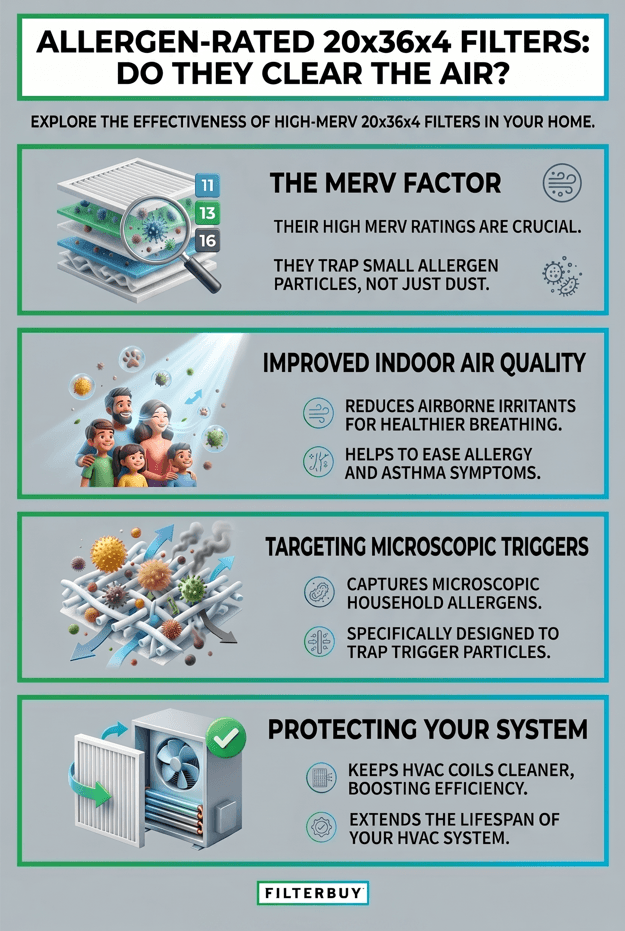
The Minimum Efficiency Reporting Value, or MERV, is the independent yardstick set by ASHRAE Standard 52.2. The test challenges an air filter against twelve particle-size channels from 0.3 to 10 microns and assigns a number from 1 to 16. MERV 8 catches pollen and large mold spores. MERV 11 adds pet dander and fine pollen fragments. MERV 13 reaches smoke particulates and many bacteria, which is the rating most allergy-sensitive families should be looking at.
Most allergen-labeled 20x36x4 filters land somewhere between MERV 8 and MERV 13. Some manufacturers publish a MERV number alongside the allergen branding. Others use proprietary scales like MPR, which is 3M's Microparticle Performance Rating, or FPR, which is Home Depot's Filter Performance Rating. Both scales translate roughly to MERV equivalents, but the brand versions are designed to look bigger and feel more impressive on the box. A 1900 MPR filter equals roughly MERV 13, and a 10 FPR filter equals roughly MERV 11.
The single best move for an allergy-sensitive home is to ignore the brand scale on the front and find the MERV number on the side panel.
Why A 4-Inch Depth Changes Allergen Performance
The 20x36x4 form factor exists because depth solves problems that thinner filters cannot. Four inches of pleated media gives the filter four to five times the surface area of a 1-inch version at the same MERV rating. More surface area means lower pressure drop, longer service life, and steadier airflow under the high static load most central systems run during peak heating and cooling months. For a home running the HVAC system around the clock during pollen season, that depth means more allergens trapped per cycle and a longer service life before the filter needs changing.
The catch is the slot. A 4-inch filter only behaves like a 4-inch filter when the furnace cabinet was built for it. If the housing has a 1-inch slot, a 20x36x4 cannot be wedged in without leaving air-bypass gaps around the frame, and bypass air carries the allergens the filter is supposed to trap directly into the duct system. Before ordering a 20x36x4, confirm the furnace filter slot depth that the manufacturer specified for your system.
Where To Find A 20x36x4 Allergen-Rated Filter
20x36x4 is not a stocked size at most big-box retailers. Walk into a Home Depot, Lowe's, Walmart, Ace Hardware, Costco, or Dollar General, and the 4-inch filter wall is built around 16x25x4, 20x25x4, and 20x20x4. The 20x36x4 dimension is usually special-order, online-only, or made-to-spec through a custom filter manufacturer. Amazon listings for this size come and go depending on third-party seller inventory. The realistic options for an allergy-sensitive home are an online subscription from a direct-to-consumer filter maker or a custom-cut order through an HVAC supplier.
The bulk subscription route is also the most reliable cost lever for this size. A six-pack delivered every six months runs less per filter than buying single units at a time, and the steady cadence matters for allergen control because a loaded filter loses capture efficiency long before it stops moving air.
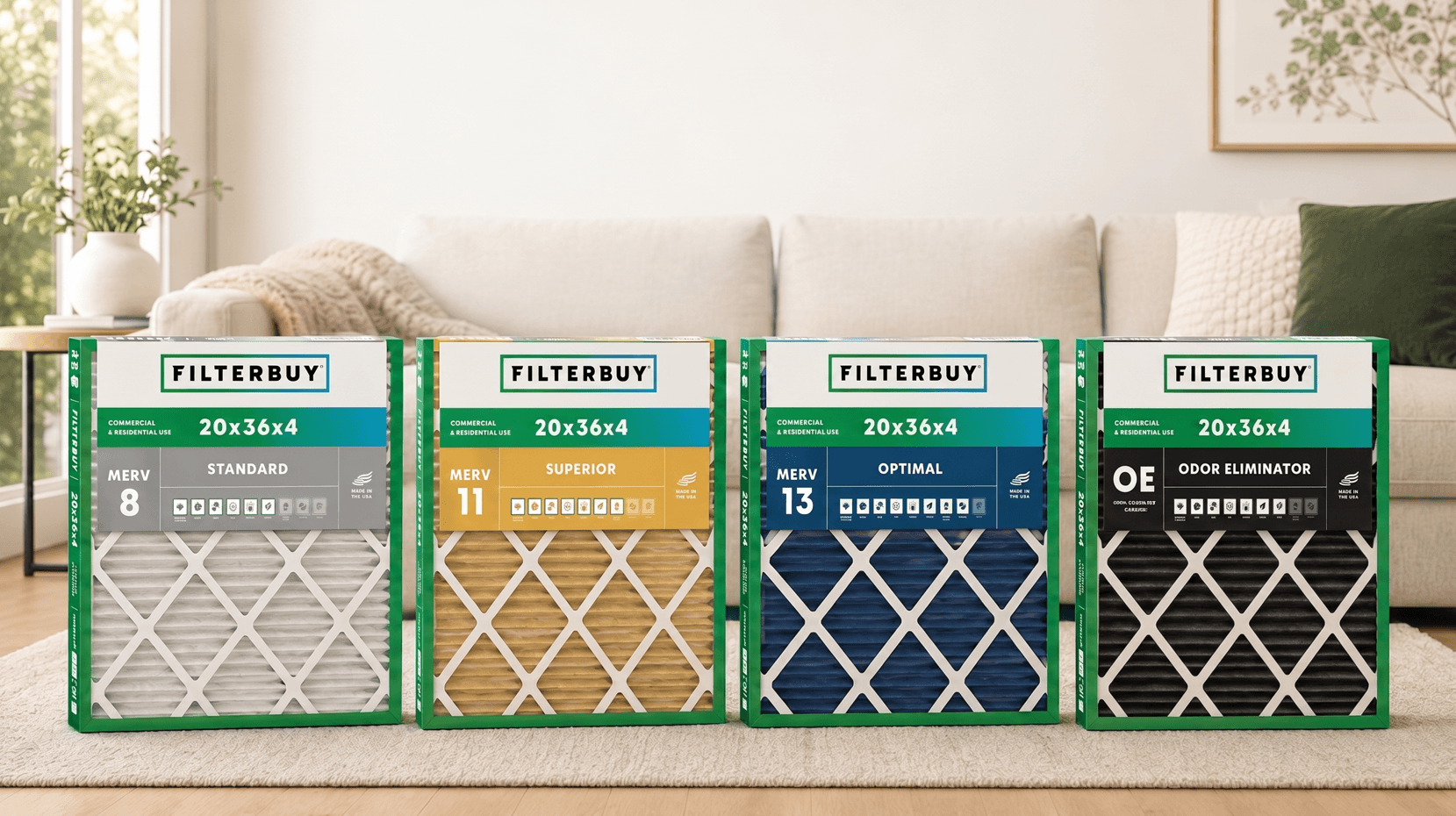
"After manufacturing filters for over a decade and serving more than two million households, we've learned to read the label before the badge. An allergen mark without a MERV number or an Asthma & Allergy Friendly certification is a marketing claim rather than a measurement, and an allergy-sensitive family deserves the measurement."
Essential Resources For Choosing A 20x36x4 Air Filter
Start With The EPA's Plain-Language Guide To Home Air Cleaners
The Environmental Protection Agency keeps a homeowner-friendly overview of how HVAC filters and portable air cleaners actually perform in residential settings. The page is honest about what filtration can and cannot do, which is the right starting frame for any allergen-rating decision.
Source: EPA guide to air cleaners and HVAC filters in the home
Read The ASHRAE Standard Behind Every MERV Number
ASHRAE Standard 52.2 is the test protocol that turns a MERV rating into a verifiable claim. The publicly posted version walks through the twelve particle-size channels the test measures, which clarifies what a MERV 11 or MERV 13 number on a 20x36x4 filter actually represents.
Source: ASHRAE Standard 52.2-2017 air filter testing protocol
Cross-Check The Allergen Claim Against AAFA Certification
The Asthma and Allergy Foundation of America runs an independent third-party Certified Asthma & Allergy Friendly program with Allergy Standards Limited. Filters that carry the mark have been tested against published criteria, which is the most useful verification an allergen claim can show.
Source: AAFA Certified Asthma & Allergy Friendly program
Use the American Lung Association Guidance To Pick A Filter Tier
The American Lung Association lays out clear MERV recommendations for residential systems and a balanced view on portable air cleaners alongside HVAC filtration. The page is useful for translating a clinical recommendation into a filter-purchase decision.
Source: American Lung Association air cleaning and filtration guidance
Match Indoor Allergen Control Steps To CDC Asthma Recommendations
The Centers for Disease Control and Prevention publishes practical indoor-trigger control steps for asthma management, including humidity targets and allergen-cover guidance. Pairing the steps with properly rated 20x36x4 air filters gives an allergy-sensitive household complete control over its plan instead of a filter-only fix.
Source: CDC controlling asthma triggers in the home
Time Your Filter Replacements Using DOE Energy-Saver Maintenance Rules
The U.S. Department of Energy maintains a homeowner-facing maintenance page that covers filter inspection cadence, energy impact of a loaded filter, and the realistic replacement window for both 1-inch and deeper filters. The DOE numbers are useful for setting a reminder schedule on a 20x36x4.
Source: DOE Energy Saver air conditioner maintenance guide
Review The Peer-Reviewed Allergen-Reduction Study From The National Library Of Medicine
A peer-reviewed study indexed by the National Library of Medicine measured the actual reduction of dust mite, cat, and dog allergens with in-home air filtration. The numbers in the paper give an allergy-sensitive household a realistic expectation for what filtration can deliver, distinct from any marketing claim.
Source: National Library of Medicine residential allergen filtration study
Supporting Statistics
1. The American Academy of Allergy, Asthma & Immunology documents that rates of allergies and asthma have risen significantly in the United States, with the hygiene hypothesis, antibiotic and acetaminophen use, obesity, and vitamin D deficiency cited as leading factors driving the trend. A growing affected population is the baseline that any 20x36x4 allergen-rated filter has to operate against.
Source: AAAAI on increasing rates of allergies and asthma in the United States
2. AHAM Verifide publishes a standardized Clean Air Delivery Rate, or CADR, that quantifies air cleaner performance against three specific challenges: tobacco smoke, dust, and pollen. The standard exists because consumer-facing performance claims on air cleaning products have historically been inconsistent without third-party verification.
Source: AHAM Verifide air filtration standards and CADR explainer
3. The American College of Allergy, Asthma & Immunology reports that more than 50 million Americans live with allergies, with allergic rhinitis ranking among the most common chronic conditions in the country. The size of the affected population is why allergen-labeled HVAC filters are a meaningful purchase category, and why verifying the underlying rating matters.
Source: ACAAI allergy facts and statistics
Final Thoughts And Opinion
In our experience working with allergy-sensitive households, the 20x36x4 form factor is one of the most useful filter sizes when the rating and the cabinet match. Where homeowners get burned is the gap between the badge on the box and the number on the side panel.
An allergen claim becomes a measurable promise the moment a published MERV rating against ASHRAE testing pairs with an Asthma & Allergy Friendly certification verified on the AAFA site. With both in hand, a 20x36x4 filter actively reduces seasonal pollen, dust mite, and pet dander exposure for the family living with it. The rating without that proof is a word on a wrapper, and an allergy-sensitive household deserves more than a word on a wrapper.
Frequently Asked Questions
Q: Is A 20x36x4 Allergen Filter The Same As A HEPA Filter?
A: No. A true HEPA filter captures 99.97 percent of particles at 0.3 microns, which sits well above MERV 17 on the testing scale. Residential 20x36x4 filters top out around MERV 13. Allergen-rated branding usually maps to MERV 8 through MERV 13, not HEPA.
Q: How Often Should I Change A 20x36x4 Allergen-Rated Filter?
A: Manufacturers typically rate 4-inch allergen filters for six to twelve months. Allergy-sensitive homes, pet households, and homes running the HVAC system year-round should aim for the shorter end of that window. A visual check every two months helps catch early loading.
Q: Will A 20x36x4 Filter Fit A Furnace Built For A 1-Inch Slot?
A: No. A 4-inch filter forced into a 1-inch housing leaves bypass gaps that let unfiltered air carry allergens straight into your ductwork. Confirm the slot depth your furnace was designed for before ordering.
Q: What MERV Rating Does An "Allergen Plus" Filter Usually Equal?
A: Most Allergen Plus, Allergen Reduction, and Allergen Defense lines fall between MERV 11 and MERV 13. Some brands publish the MERV equivalent on the side panel. If the package shows only a proprietary scale like MPR or FPR, look for the manufacturer's MERV conversion chart.
Q: How Do I Install A 20x36x4 Air Filter?
A: Turn off the system at the thermostat. Open the filter cabinet door. Slide the old filter out and note which way the airflow arrow points. Slide the new 20x36x4 in with its arrow pointing the same direction toward the blower. Close the cabinet door. Restart the system.
Q: Where Can I Buy A 20x36x4 Filter Near Me?
A: Most big-box retailers do not stock 20x36x4 because the dimensions are off-standard. The realistic options are an online direct-to-consumer filter maker, an Amazon third-party seller, or a custom order through a local HVAC supplier.
Q: Is A 20x36x4 Carbon Or Charcoal Filter Better For Allergies Than A Pleated One?
A: For airborne allergens specifically, a pleated filter at MERV 11 or MERV 13 captures more particle mass than a carbon or charcoal filter at the same depth. Carbon adds odor and volatile organic compound reduction, which helps with chemical sensitivities but is a separate benefit from allergen control.
Take The Next Step Toward Verifiable Allergen-Filtered Air
Before ordering another 20x36x4 filter for an allergy-sensitive home, flip the box and look for a published MERV number or an Asthma & Allergy Friendly certification mark from AAFA. Either one turns an allergen rating into a measurable promise instead of a marketing word.
Learn more about HVAC Care from one of our HVAC solutions branches…
Filterbuy HVAC Solutions - Weston FL
2573 Mayfair Lane Weston FL 33327
(754) 296-3528
https://maps.app.goo.gl/E3tjmKf5VSWYghGc7