That sticky, clammy feeling inside your Ocoee home means one thing—your AC has stopped removing moisture from the air.
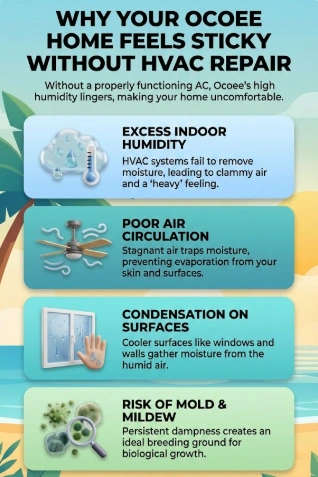
The technicians see this constantly in Central Florida: a struggling HVAC system turns comfortable homes into humid boxes within hours. We've measured indoor humidity levels spike past 70% in Ocoee homes with failing compressors or refrigerant leaks—making 74°F feel unbearable.
Here's what most homeowners don't realize: your air conditioner is a dehumidifier first. Cool air is just the byproduct. When any component underperforms, moisture removal fails before you ever notice a temperature change.
This page breaks down exactly why HVAC problems create sticky indoor air, the warning signs we look for during diagnostics, and how targeted repairs restore comfortable humidity levels—often within a single service visit.
Quick Answers
HVAC Repair in Ocoee
HVAC repair in Ocoee addresses cooling, heating, and humidity control failures in residential and commercial systems. Central Florida's subtropical climate—with outdoor humidity averaging 74% year-round—makes functional air conditioning essential for both comfort and home protection.
Common repairs we perform in Ocoee include:
Refrigerant leak detection and recharge
Evaporator and condenser coil cleaning or replacement
Condensate drain clearing
Capacitor and contactor replacement
Compressor diagnosis and replacement
Thermostat calibration and replacement
What Ocoee homeowners should know:
Your AC removes 5-20 gallons of moisture from indoor air daily when functioning properly
Humidity problems often appear before temperature issues—sticky air is an early warning sign
EPA recommends indoor humidity stay between 30-50%; levels above 60% promote mold growth
Florida law requires all HVAC contractors to hold valid DBPR licensing
Before scheduling service:
Verify contractor license at myfloridalicense.com
Get 2-3 written estimates
Ask specifically how they'll test dehumidification performance
Typical repair costs in the Ocoee area:
Minor repairs: $150–$400
Moderate repairs: $400–$1,000
Major component replacement: $1,200–$2,500
A properly diagnosed repair restores comfort, lowers energy bills, and prevents secondary damage from uncontrolled humidity. Most repairs are completed in a single service visit.
Top Takeaways
Your AC is a dehumidifier first. Cool air is the byproduct. Moisture removal fails before temperature changes—explaining why 72°F still feels uncomfortable.
60% humidity is the danger threshold. Levels above 60% trigger mold growth and dust mite proliferation. We routinely measure 65-75% in Ocoee homes with undiagnosed HVAC issues.
Delayed repairs compound costs. A $200 fix today can prevent $3,000 in mold remediation later. Energy bills, health effects, and hidden damage accumulate monthly.
Central Florida demands more from your system. Outdoor humidity averages 74% year-round. Florida AC accounts for 28% of home energy use—the highest nationally.
Verify before you hire. Check licenses through Florida DBPR. Get multiple estimates. Ask how they test dehumidification—not just cooling.
How HVAC Problems Create That Sticky Feeling
Your air conditioner is a dehumidifier first—it removes 5-20 gallons of water from indoor air daily by condensing moisture on cold evaporator coils. When any part of this system fails, that moisture stays inside your home and clings to everything, including your skin.
The most common culprits we diagnose in Ocoee homes include low refrigerant levels, frozen coils, clogged condensate drains, and oversized units that cycle too quickly to pull moisture out. Each problem reduces dehumidification capacity while the system may still blow cool air—which is why your thermostat reads 72°F but the room feels heavy and uncomfortable.
Central Florida's year-round humidity averaging 74% makes this worse. Unlike drier climates, you can't open windows for relief. Professional HVAC repair in Ocoee restores full moisture removal by targeting the exact component causing the failure—and most homeowners notice lighter, more comfortable air immediately after service.
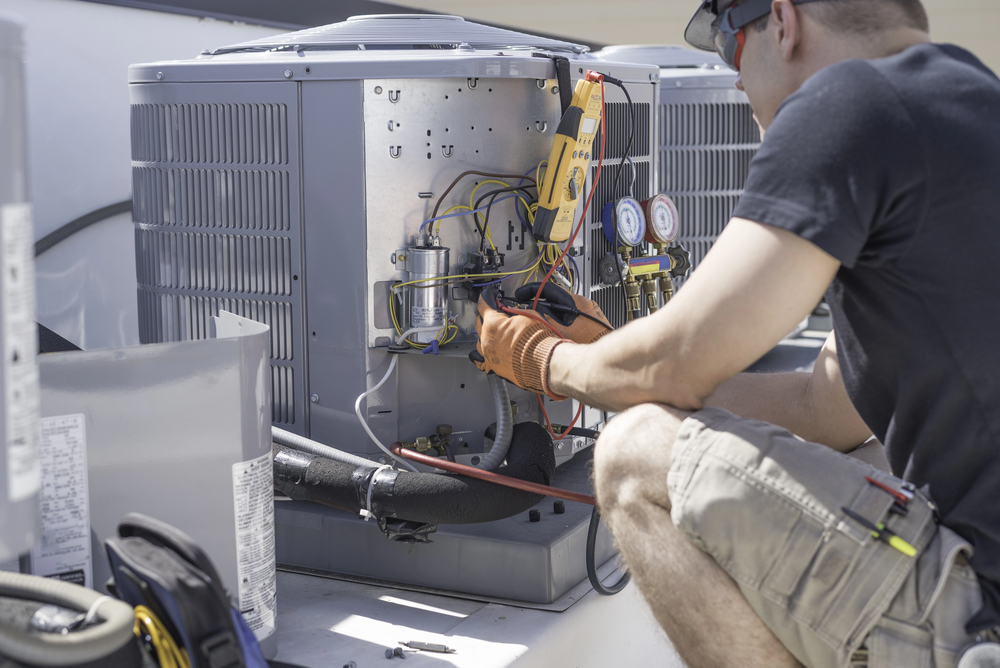
"Nine times out of ten, when an Ocoee homeowner calls about sticky air, we find the AC is still cooling but a refrigerant leak or drainage issue killed the dehumidification weeks ago—they just didn't connect the two until comfort became unbearable."
Essential Resources for Hiring a Trusted HVAC Contractor in Ocoee
1. Verify Florida Contractor Licenses Before Signing Any Agreement
Confirm any HVAC company holds valid state certification through Florida's official licensing database. Search by company name or license number to check status, expiration dates, and disciplinary history.
Source: Florida Department of Business & Professional Regulation
URL: https://www.myfloridalicense.com/wl11.asp
2. Understand Healthy Indoor Humidity Levels Set by the EPA
Learn why the EPA recommends keeping indoor humidity between 30-50% and how HVAC problems allow moisture to exceed safe thresholds. Essential context for evaluating repair urgency.
Source: U.S. Environmental Protection Agency
URL: https://www.epa.gov/indoor-air-quality-iaq/care-your-air-guide-indoor-air-quality
3. Compare Repair vs. Replacement Using Energy Star Guidelines
Access federal guidance on HVAC efficiency ratings, maintenance best practices, and cost-benefit analysis for repair versus replacement decisions. Includes tips for hiring qualified contractors.
Source: U.S. Department of Energy – Energy Star Program
URL: https://www.energystar.gov/saveathome/heating-cooling
4. Check Contractor Ratings and Complaints Through the BBB
Search Better Business Bureau profiles for Central Florida HVAC companies to review accreditation status, customer ratings, complaint history, and resolution records.
Source: Better Business Bureau
URL: https://www.bbb.org/near-me/heating-and-air-conditioning
5. Protect Yourself from HVAC Repair Scams with FTC Guidelines
Review federal warning signs of contractor fraud, including pressure tactics, cash-only demands, and unlicensed operators. Learn contract requirements and safe payment practices.
Source: Federal Trade Commission – Consumer Advice
URL: https://consumer.ftc.gov/articles/how-avoid-home-improvement-scam
6. Find Quality-Certified Contractors Through ACCA's National Directory
Locate HVAC contractors certified by the Air Conditioning Contractors of America—the industry organization that sets national installation and service quality standards.
Source: Air Conditioning Contractors of America
URL: https://hvac-contractors.acca.org/locator
7. File Complaints Through Florida's Consumer Protection Portal
Report unresolved contractor disputes to the state's official consumer protection clearinghouse. Access mediation services and document issues for potential enforcement action.
Source: Florida Department of Agriculture and Consumer Services
URL: https://www.fdacs.gov/Contact-Us/File-a-Complaint
Supporting Statistics on Indoor Humidity and HVAC Performance
Statistic 1: The 60% Humidity Threshold
Our technicians carry humidity meters on every Ocoee service call. We routinely measure indoor levels between 65-75% in homes with failing AC components.
EPA guidelines confirm:
Indoor humidity should stay between 30-50%
Levels above 60% create conditions for mold growth
Prolonged exposure above 60% causes structural damage
In Central Florida's climate, your air conditioner is the only barrier keeping humidity below that threshold.
Source: U.S. Environmental Protection Agency – Mold Course Chapter 2
https://www.epa.gov/mold/mold-course-chapter-2
Statistic 2: HVAC Accounts for 52% of Home Energy Use
When customers call about rising electric bills, HVAC problems are almost always the cause.
Federal data shows:
Heating and cooling represent 52% of household energy consumption nationwide
Florida air conditioning alone accounts for 28% of residential energy use—the highest in the nation
A struggling system runs longer cycles while removing less moisture
We've seen monthly bills drop $40-60 after targeted repairs restore efficiency.
Source: U.S. Energy Information Administration – Residential Energy Consumption Survey
https://www.eia.gov/energyexplained/use-of-energy/homes.php
Statistic 3: Mold Linked to 30-70% Increase in Respiratory Symptoms
We take humidity complaints seriously. The health consequences are well-documented.
Research findings:
Homes with dampness and mold show 30-70% higher rates of respiratory symptoms
Asthma complications increase significantly in high-humidity environments
Children and those with existing conditions face elevated risk
After years of service calls, we've noticed a pattern. Families reporting allergy flare-ups or breathing issues often have systems that cool adequately but stopped dehumidifying weeks earlier. CDC and Institute of Medicine research confirms what we observe in the field.
Source: Lawrence Berkeley National Laboratory – Indoor Air Quality Scientific Findings Resource Bank
https://iaqscience.lbl.gov/dampness-and-mold
Final Thought on HVAC Repair and Indoor Comfort in Ocoee
That sticky, uncomfortable feeling is not something to ignore. It's a symptom of partial HVAC failure—even if cool air still flows.
After servicing thousands of systems across Central Florida, here's our honest perspective: most homeowners wait too long because the house still feels cool. By the time discomfort becomes unbearable, secondary damage has often started.
What this page covered:
Your AC is a dehumidifier first—cool air is the byproduct
Low refrigerant, frozen coils, and clogged drains kill moisture removal before affecting temperature
EPA sets 60% humidity as the mold growth threshold
Ocoee's subtropical climate demands more from HVAC systems than most U.S. regions
Malfunctioning systems cost more to operate while delivering less comfort
Prolonged humidity exposure increases respiratory symptoms by 30-70%
Our take on delayed repairs:
The real cost isn't just discomfort. It's compounding damage:
Higher energy bills accumulating month after month
Health effects that build gradually and go unconnected
Moisture problems spreading behind walls where you can't see them
We've walked into homes where a $200 refrigerant recharge would have prevented $3,000 in mold remediation. We've seen families live with chronic allergy symptoms for months—never connecting it to an AC that cooled fine but failed on humidity control.
Before you hire:
Verify any contractor's license through Florida DBPR
Get multiple estimates
Ask specifically how they'll test dehumidification performance—not just cooling output
Your home should feel comfortable. If it doesn't, something needs to be fixed.
FAQ on HVAC Repair in Ocoee
Q: How do I verify an HVAC contractor is licensed in Florida?
A: Search the contractor's name or license number at myfloridalicense.com through Florida DBPR. We encourage every homeowner to do this—even for us.
The search takes two minutes and shows:
License status (active or expired)
Certification type
Complaint and disciplinary history
In our experience, unlicensed operators quote low upfront then add charges mid-job—or disappear entirely. A valid state license is non-negotiable.
Q: What are signs my AC needs repair versus replacement?
A: The signals we look for include:
Warm air from vents
Unusual noises
Frequent cycling
Rising energy bills
Humidity problems despite cool temperatures
Here's what most homeowners don't realize: age alone doesn't determine the answer. We've repaired 18-year-old systems that ran another five years. We've also recommended replacing 8-year-old units where repair costs exceeded 60% of replacement value.
Our approach: diagnose first, then present honest options with real numbers.
Q: Why does my Ocoee home feel sticky even when the AC is running?
A: This is our most common complaint in Central Florida. Your system is cooling but not dehumidifying.
Nine times out of ten, we trace this to:
Low refrigerant levels
Frozen evaporator coils
Clogged condensate drains
Oversized units cycling too fast
What surprises homeowners: the temperature reads fine, so they assume everything works. Meanwhile, indoor humidity climbs past 70% and moisture damage starts silently. We carry meters on every call specifically to catch this.
Q: How much does HVAC repair typically cost in Ocoee?
A: Based on our service history, common repairs fall into these ranges:
Our advice:
Get 2-3 written estimates
Confirm parts, labor, and warranty in writing
Be cautious of quotes significantly below these ranges—underpriced bids often mean corner-cutting or hidden fees
Q: How quickly should I address HVAC humidity problems?
A: Immediately. We say this from experience, not sales pressure.
Key facts:
EPA confirms mold can grow within 24-48 hours once humidity exceeds 60%
In Ocoee's climate, humidity problems accelerate—they don't plateau
What we've seen: A $200 service call would have solved everything. The homeowner waited three months because the air still felt cool. Mold spread behind the master bedroom wall. Final remediation cost: over $4,000.
If your home feels sticky, call someone this week—not next month.
Here is the nearest branch location serving the Jupiter FL area…
Filterbuy HVAC Solutions - West Palm Beach FL
1655 Palm Beach Lakes Blvd ste 1005, West Palm Beach, FL 33401
(561) 448-3760