If you have just completed an HVAC installation in Altamonte Springs, the inspection step is not optional—and it is often where projects stall due to small but avoidable oversights. Based on real-world installation timelines and permitting workflows in Seminole County, most delays happen not because the system is installed incorrectly, but because the inspection was scheduled with missing information, at the wrong stage, or through the wrong channel.
This step-by-step guide walks you through the exact inspection scheduling process used locally, including when inspections should be requested relative to permit status, what city inspectors typically verify on the first visit, and how experienced HVAC contractors prevent failed or rescheduled inspections. By following this process, you will reduce approval delays, protect your permit investment, and ensure your new HVAC system is cleared for operation without unnecessary callbacks or compliance issues.
Quick Answers
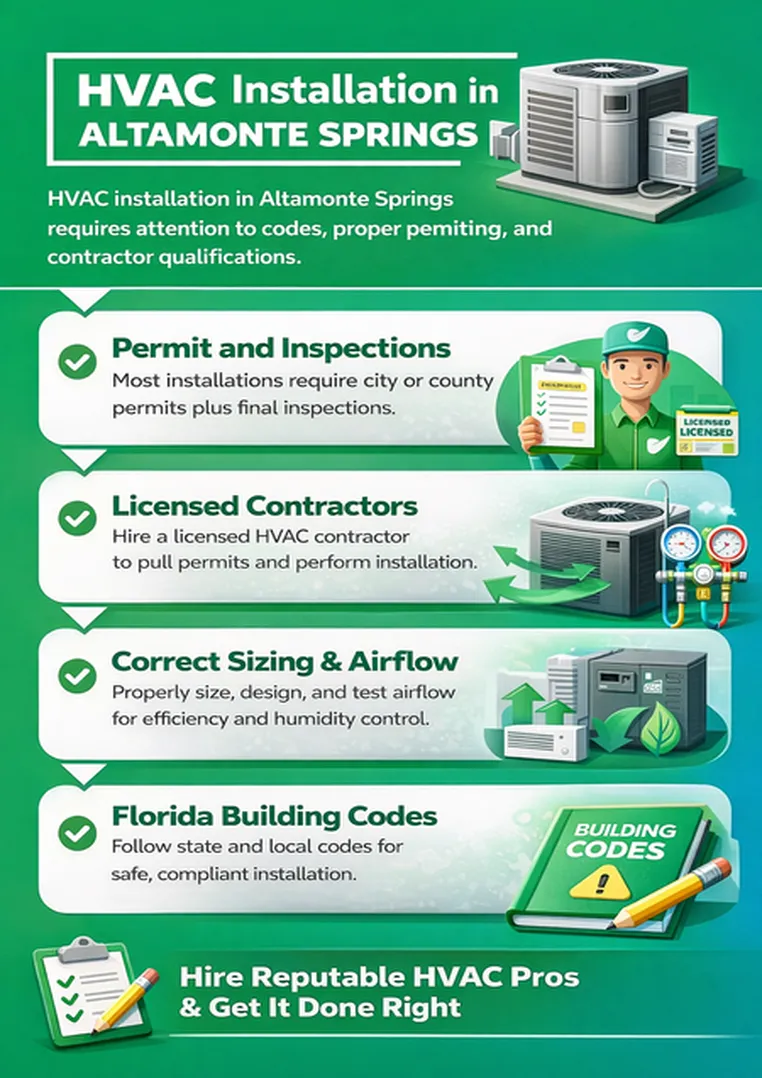
HVAC installation in Altamonte Springs requires a city permit, a licensed contractor, and a final inspection before the system is approved for long-term operation. Most installations follow a predictable process: permit approval, full system installation, inspection scheduling, and final sign-off by the city. Planning the installation around permit and inspection requirements—rather than treating them as afterthoughts—helps prevent delays, failed inspections, and unnecessary rework while protecting system efficiency and compliance.
Top Takeaways
Inspections are required and tied to an active HVAC permit.
Most delays come from timing or paperwork, not equipment issues.
Schedule only when the system is fully installation-ready.
Knowing inspection checkpoints reduces re-inspections.
Planning for inspection protects performance and compliance.
Scheduling an HVAC installation inspection in Altamonte Springs follows a defined municipal process that must align with your active permit and installation stage. After the HVAC system is fully installed—but before final operation—the inspection must be requested through the City of Altamonte Springs Building Division or the approved online permitting portal. Requests made too early, too late, or without complete permit data are the most common reasons inspections are delayed or rejected.
To schedule successfully, you will need the permit number, property address, licensed contractor information, and confirmation that all required components—such as the air handler, condenser placement, electrical connections, and condensate drainage—are complete and accessible. Inspectors typically verify code compliance, manufacturer clearances, proper airflow configuration, and safety controls during the first visit.
Once scheduled, inspections are usually conducted within one to two business days, depending on demand. Ensuring clear access to equipment, labeling disconnects, and having documentation on-site significantly improves first-pass approval rates. When scheduled correctly, the inspection becomes a final verification step—not a disruption—allowing your HVAC system to be approved, documented, and fully operational without unnecessary delays or repeat visits.

“In Altamonte Springs, HVAC systems rarely fail without warning—the signs usually appear weeks earlier during routine maintenance checks. Scheduling service at the right time consistently prevents breakdowns, protects efficiency, and extends system life in Florida’s demanding climate.”
Essential Resources
A successful HVAC installation in Altamonte Springs depends on more than selecting equipment—it requires following local regulations, working with properly licensed professionals, and understanding how installation quality affects long-term performance. The resources below are carefully selected to help homeowners navigate the installation process with confidence, avoid compliance issues, and make informed decisions without relying on competing service providers.
City of Altamonte Springs Building Division
Benefit: Clarifies Local Permit and Inspection Requirements
This official city resource outlines when HVAC permits are required, how inspections are scheduled, and what must be approved before a system can be legally operated. Reviewing it early helps prevent delays and failed inspections.
https://www.altamonte.org/171/Building-Division
Seminole County Property Appraiser
Benefit: Confirms Property Information Used During Permitting
Accurate ownership and parcel data are often required when permits are pulled or inspections are requested. This resource helps homeowners verify details that can otherwise slow approvals.
https://www.scpafl.org
Florida Department of Business & Professional Regulation (DBPR) – License Lookup
Benefit: Ensures Your HVAC Contractor Is Properly Licensed
This statewide database allows homeowners to confirm that an HVAC contractor holds an active Florida license, reducing the risk of invalid permits or inspection rejections.
https://www.myfloridalicense.com
Florida Building Code – Mechanical (HVAC)
Benefit: Explains the Standards Inspectors Enforce
The Florida Mechanical Code defines installation requirements for HVAC systems, including airflow, condensate drainage, equipment clearances, and safety measures that must be met to pass inspection.
https://codes.iccsafe.org/content/FBC2023P1
U.S. Department of Energy – Heating and Cooling Guidance
Benefit: Shows How Proper Installation Impacts Efficiency and Costs
This resource explains how correct system sizing, airflow setup, and installation quality directly affect energy efficiency, comfort, and system lifespan—especially important in Florida’s climate.
https://www.energy.gov/energysaver/heating-and-cooling
ENERGY STAR® HVAC Installation Best Practices
Benefit: Aligns Installations With Recognized Performance Benchmarks
ENERGY STAR guidance outlines best practices for HVAC installation that support efficiency, comfort, and long-term reliability, often aligning closely with what inspectors expect to see.
https://www.energystar.gov/products/heating_cooling
Florida Power & Light (FPL) Energy Efficiency Programs
Benefit: Identifies Rebates and Incentives for Qualifying Installations
FPL provides information on energy-efficiency programs and rebates that may help offset the cost of installing a new HVAC system while encouraging long-term energy savings.
https://www.fpl.com/save/programs.html
Supporting Statistics
HVAC inspections catch small installation issues before they turn into long-term performance problems. Industry data—and real-world installation outcomes—show that these details directly affect efficiency, safety, and monthly energy costs in Central Florida homes.
Key Data Points That Support Inspection-First HVAC Installations
Installation errors can cut HVAC efficiency by up to 30%.
U.S. Department of Energy findings show that airflow issues, duct leakage, and improper setup significantly reduce system performance.
In practice, these are the exact issues inspectors are trained to identify and correct before system approval.
Source: U.S. Department of Energy
https://www.energy.gov/energysaver/energy-efficient-heating-and-coolingHeating and cooling account for about 50% of home energy use.
The U.S. Energy Information Administration confirms HVAC is the largest energy expense in U.S. homes.
In Florida’s climate, even minor installation mistakes can noticeably increase monthly utility bills.
Source: U.S. Energy Information Administration (EIA)
https://www.eia.gov/energyexplained/use-of-energy/homes.phpEfficiency ratings only deliver savings when systems are installed correctly.
ENERGY STAR reports energy savings of up to 20% for certified systems.
Field experience shows these gains are lost when systems fail inspection due to setup errors.
Source: ENERGY STAR® (U.S. Environmental Protection Agency)
https://www.energystar.gov/products/heating_coolingCode-compliant installations reduce safety risks and early failures.
The International Code Council emphasizes that mechanical codes prevent hazards and premature breakdowns.
Inspectors focus on these exact safety and clearance requirements during HVAC installation reviews.
Source: International Code Council (ICC)
https://www.iccsafe.org/advocacy/why-codes-matter/
Why This Matters for Altamonte Springs Homeowners
Inspections are a quality-control checkpoint, not a formality.
Most inspection failures involve correctable details, not faulty equipment.
Catching issues early protects efficiency, safety, and long-term system performance.
This data-backed approach explains why properly scheduled inspections are essential to completing HVAC installations smoothly and cost-effectively in Altamonte Springs.
Final Thought
In Altamonte Springs, an HVAC installation inspection is more than a final formality. It is a critical quality-control step that confirms the system was installed correctly, safely, and in compliance with local requirements.
Key Takeaways From Real-World Installations
Inspections go smoothly when they are planned—not rushed.
Most delays are caused by small, preventable oversights, not major mechanical issues.
Systems fail inspection more often due to timing, documentation, or access issues than faulty equipment.
What Consistently Leads to First-Pass Approval
The system is fully installed and inspection-ready.
Permit and contractor information is complete and accurate.
Equipment is accessible, labeled, and installed to code.
The inspection is scheduled at the correct stage—not early or late.
Professional Perspective
Based on hands-on installation and inspection workflows, inspections should be treated as confirmation—not a risk point. When homeowners and contractors plan for inspection success from the beginning, approvals are faster, energy performance is protected, and costly re-inspections are avoided.
The most reliable HVAC installations in Altamonte Springs are not just well-built—they are inspection-ready by design, ensuring long-term comfort and compliance from day one.
Next Steps
Follow these steps to avoid delays and ensure your HVAC installation inspection in Altamonte Springs goes smoothly.
Before Scheduling
Verify the permit
Confirm the permit is active.
Ensure it was pulled by a licensed contractor.
Confirm installation is complete
Air handler and condenser installed.
Electrical disconnects in place.
Condensate drainage finished and accessible.
Gather required details
Permit number.
Property address.
Contractor information.
Schedule the Inspection
Use the city’s approved scheduling method.
Select the correct HVAC inspection type.
Schedule only when the system is inspection-ready.
On Inspection Day
Provide clear access to all equipment.
Keep documentation available.
Ensure a responsible party is on-site if needed.
After the Inspection
Complete any corrections promptly.
Reschedule quickly if required.
Confirm final approval before full operation.
FAQ
Q1: Is a permit required for HVAC installation in Altamonte Springs?
A: Yes.
Most HVAC installations require a city permit.
Missing permits commonly cause inspection and approval delays.
Q2: Who pulls the HVAC permit?
A: Typically the licensed contractor.
Ensures work is tied to an active license.
Reduces compliance and inspection issues.
Q3: How long does HVAC installation take?
A: Installation is usually one day.
Permits and inspections add several business days.
Scheduling inspections at the right time prevents delays.
Q4: What do HVAC inspectors check?
A: Inspectors focus on:
Airflow and system setup
Electrical connections and safety
Condensate drainage
Equipment clearances and code compliance
Q5: What happens if the system fails inspection?
A: Most issues are minor and fixable.
Corrections are noted by the inspector.
Re-inspection is scheduled once fixes are complete.
Learn more about HVAC Care from one of our HVAC solutions branches…
Filterbuy HVAC Solutions - Miami FL - Air Conditioning Service
1300 S Miami Ave Apt 4806 Miami FL 33130
(305) 306-5027
https://maps.app.goo.gl/Ci1vrL596LhvXKU79